

The Difference Between Forward and Backward Curved Fans
If you’re not familiar with industrial fans, figuring out the difference between a forward and backward curved fan can feel a bit confusing. Sure, the names give away the blade direction, forward or backward, but that’s only scratching the surface. The real difference comes down to how they perform. How much air they move, how much pressure they can handle, how noisy they are, and how efficient they are.
And that matters. Because when you're designing a system, whether it's for ventilation, cooling, or dust control, choosing the right fan can make or break its performance.
Here’s a quick way to think about it. Imagine you’re trying to blow leaves off your driveway. If you take a big breath and blow with your mouth wide open, you’ll move a lot of air, but not very far. That’s like a forward curved fan. Now try blowing through a straw, less air, but way more focused and forceful. That’s more like a backward curved fan.
Both approaches move air, but they do it very differently.
So, let’s dig a little deeper. We’ll look at their core differences, when they excel, and when they don’t. Because forward and backward curved centrifugal fans differ in their design characteristics, making them suitable for distinct applications.
Forward Curved Fans
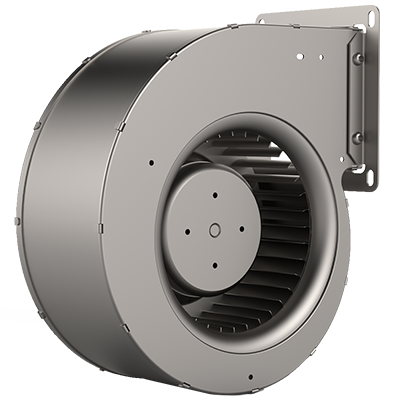
Forward curved centrifugal fans offer a compact and cost-effective solution. They’re designed for applications that need high airflow at relatively low static pressure. While they can be efficient in terms of size and cost, they’re generally less energy efficient than backward curved fans, but that really depends on how they're used.
As the saying goes, if you judge a fish and a monkey by their ability to climb a tree, you’re missing the point. It’s all about the right fan for the right job.
Their space-saving design with an external rotor motor built into the fan housing, makes them a great fit for tight or confined spaces.
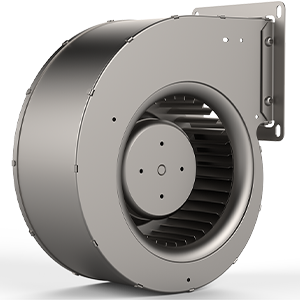
Forward curved fans have many closely spaced blades angled in the direction of impeller rotation, allowing them to move a lot of air at low pressure. They perform best in low-resistance systems, but at higher speeds or under load, they can create more turbulence and noise than their backward curved counterparts.
You’ll often find them in HVAC systems and air filtration units, especially where space is limited and moderate airflow is needed.
However, if your system has significant pressure resistance or pressure drops, a forward curved fan might not be the best option. In those cases, it may struggle to maintain performance and could even overload. That’s when a backward curved fan is likely the better choice.
And that’s a perfect time for us to look at backward curved fans in depth too:
Backward Curved Fans
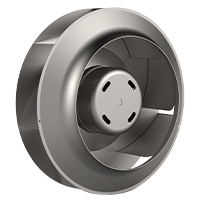
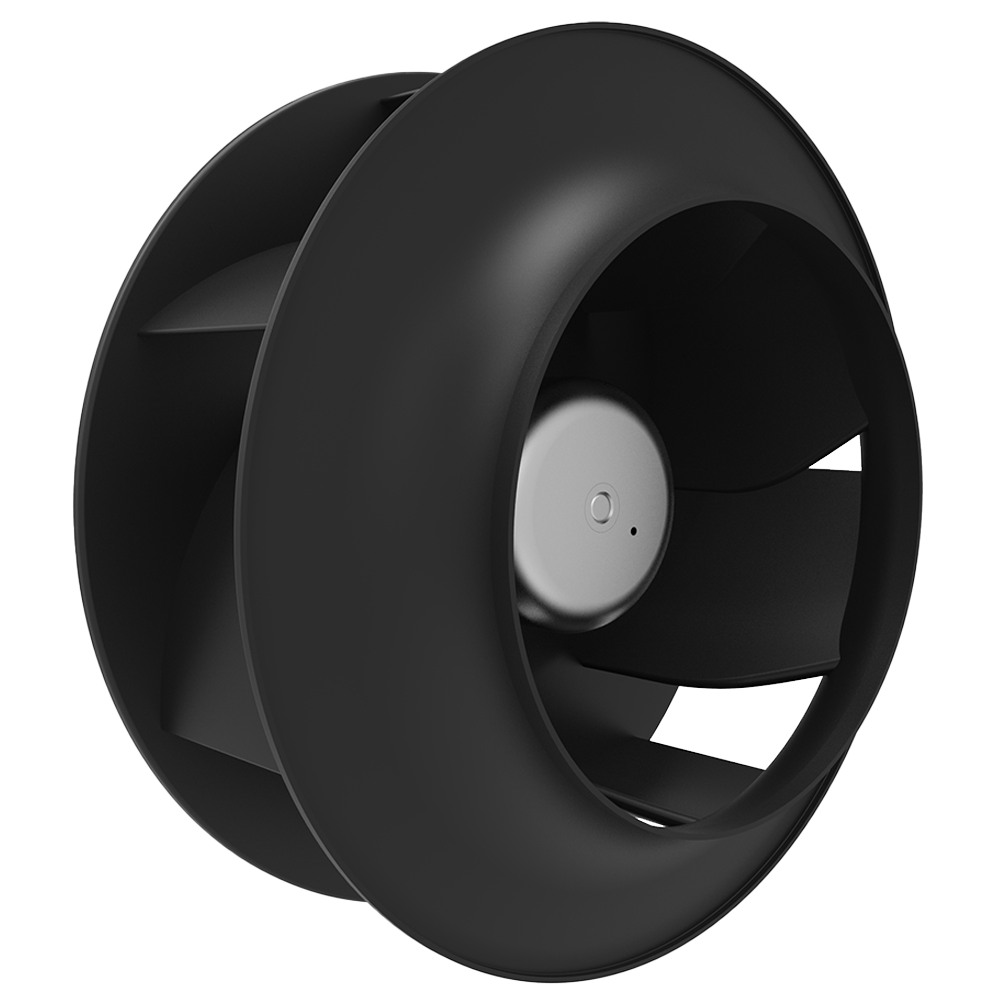
Backward curved fans are designed to handle high static pressure and overcome pressure drops, making them ideal for systems where airflow resistance is a challenge. Their blades are angled opposite to the direction of impeller rotation, hence the name “backward curved.” This design gives them an edge in both efficiency and durability, especially in demanding environments.
Unlike forward curved fans, backward curved fans typically have fewer, thicker blades. This not only improves airflow efficiency but also reduces the build-up of dust and debris, making them suitable for both clean and dirty systems.
They’re great at maintaining steady performance under pressure, offering better airflow control, higher pressure capability, and greater energy efficiency. And while noise always depends on the setup, backward curved fans tend to run quieter under load, especially when compared to forward curved fans working at similar output.
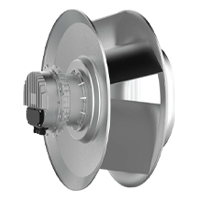
You might notice that backward curved fans don’t all look the same, some have five blades (we’re looking at you, I wheel), others six or seven (hello E wheel). That’s no accident. The number of blades, their pitch (angle), and even the material they’re made from all depend on the specific performance requirements of the application.
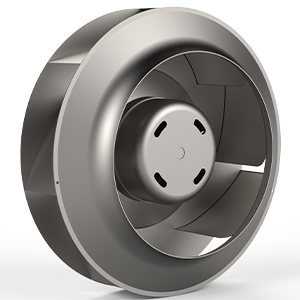
Fewer blades can reduce resistance and improve efficiency at higher speeds, while more blades may offer smoother airflow in lower speed systems. Blade pitch affects how aggressively the fan can move air, a steeper angle can deliver more pressure but might require more power.
Materials vary too. Aluminium like our I series, steel like our G series, or fibre reinforced blades, hello E wheel, are chosen based on factors like temperature, corrosion resistance, and weight. It’s all about balancing performance, durability, and energy use. So what works best will depend entirely on your system's needs.
You’ll often see them in more demanding applications, like HVAC systems, cleanrooms, industrial processes, and data centres, where consistent performance and efficiency really matter.
| Feature | Forward Curved Fan | Backward Curved Fan |
| Blade Direction | In direction of impeller rotation | Against direction of impeller rotation |
| Blade Characteristics | Many closely spaced blades | Fewer, thicker blades |
| Static Pressure | Low | High |
| Air Volume | High | Moderate to high |
| Energy Efficiency | Lower | Higher |
| Noise (at high speed) | Higher | Lower under load |
| Dust Handling | Less tolerant | More tolerant |
| Size & Cost | Compact and economical | Larger, higher initial cost |
| Applications | HVAC, filtration, small enclosures | Industrial, cleanrooms, high-resistance systems |
Get in touch with us or view a few of our forward and backward curved ranges using the product links below: