


Cooling Tower Ventilation Challenges: The Role of Industrial Fans
If you’re searching for a fan supplier to help you to overcome challenges with air movement in cooling towers such as inefficient cooling, high energy bills, excessive noise, or reliability concerns, it’s useful to understand how fan selection and system design can directly address common ventilation issues.
Why Fan Selection Matters in Cooling Towers?
A well-informed approach to fan selection can help resolve any challenges and improve the long-term performance of your cooling tower.
Cooling towers are vital for removing heat from industrial processes and HVAC systems. The right fan setup ensures these systems run efficiently, preventing overheating, and avoids costly downtime.
Industries like power generation, petrochemicals, manufacturing, and data centers all rely on effective cooling tower fans in their processing.
As touched on in the table below, we frequently help industry engineers overcome challenges in cooling tower applications such as:
- Frequent breakdowns or overheating
- High energy bills
- Excessive noise
- Maintenance difficulties
- Lack of system redundancy (risk of total shutdown if a fan fails)
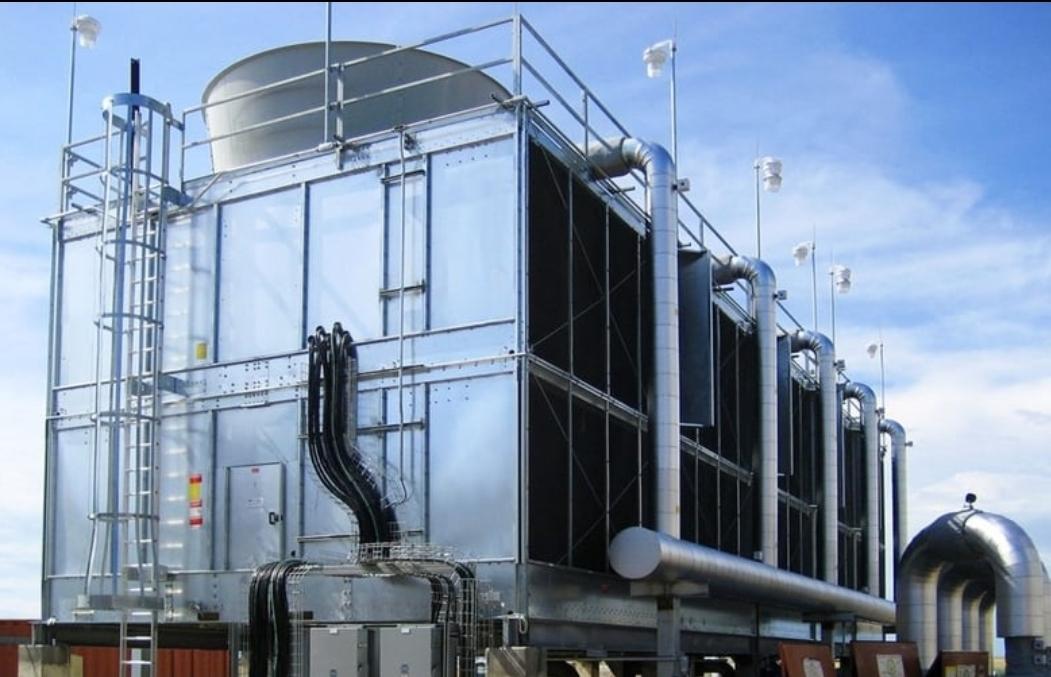
| Issues with Unoptimised Cooling Towers | Industrial Fans Selections for Cooling Towers |
| Insufficient cooling | Correctly sized, high-efficiency fans matched to your application |
| High energy costs | Modern, efficient multi-fan systems, advanced blade designs |
| Excessive noise | Low-noise fan models, aerodynamic retrofits, multi-fan configurations |
| Reliability issues | Redundant multi-fan setups, robust construction and easy maintenance |
| Difficult maintenance | Modular, accessible fan units and supplier support |
Types of Fans and Configurations
In the UK market, engineers who aren't directly in the cooling tower niche are generally more familiar with the terms “supply and extract" rather than “forced and induced draft”, unless you’ve worked specifically with industrial process cooling that is, so for clarity and knowledge enhancement, we’ll use these terms interchangeably.
- Forced draft is the supply, and
- Induced is the extract in a general ventilation system.
Choosing between forced draft (supply), induced draft (extract), single fan, or multi-fan setups depends on factors like space, performance goals, noise restrictions, and maintenance capacity. But what’s the difference and how are these installed in cooling towers?
Forced Draft Fans: These fans push air into the cooling tower, typically from the base or side. Like a supply fan in HVAC, or filter fans supplying cool air into an electrical enclosure.
Pros: More compact
Cons: Can be noisier and less efficient at airflow control.
Induced Draft Fans: These fans pull air up and out of the cooling tower, usually from the top. Like an extract fan in ventilation, or reverse-flow fan filters in enclosure cooling.
Pros: Quieter, more efficient, and offer better airflow control.
Single Large Fan: Traditional but risky, if it fails, the whole system stops. Often noisier and less efficient.
Multiple Smaller Fans: This is now the go-to approach. Offers redundancy, easier maintenance, smoother airflow, and quieter operation. If one fan fails, others compensate, keeping your process online. Check out our multiple fan array solution, the ECFanGrid.
Though FanGrid systems, multiple smaller fans arranged in a grid configuration, are increasingly favoured in new cooling tower designs and retrofits because they improve reliability, allow for flexible capacity control, and simplify both installation and replacement, but ultimately your decision if to go with forced draft/supply and induced draft/extract, or single vs. multi-fan setups, depends on:
- Cooling load
- Available space
- Noise restrictions
- Maintenance resources
- Energy efficiency goals
Cooling Tower Types
Wet Cooling Towers: Fans drive airflow across water sprayed over fill material. Heat is removed via evaporation, with cooled water collected for recirculation.
Dry Cooling Towers: Fans force or induce air over finned heat exchangers to cool the process fluid, without water evaporation.
Hybrid Cooling Towers: Designed to switch between wet and dry cooling or operate both simultaneously. They adapt to changing operational needs, improving water and energy efficiency.
Fan Selection Information
When we as the fan supplier haven't physically seen the application site, we rely heavily on clear, technical, and application-specific information from you, or the specifier. Here's a breakdown of the critical information we, or any other fan supplier typically needs to correctly select a fan for a cooling tower (wet, dry, or hybrid).
1. Cooling Load Requirements:
- Airflow volume (m³/h or CFM)
- Static pressure (Pa)
- Cooling duty (kW or BTU/h rejection rate)
2. Cooling Tower Type:
- Is it wet, dry, or hybrid?
- Evaporative cooling, dry convective cooling, or a combination?
3. Airflow Direction:
- Forced draft (supply)
- Induced draft (extract)
4. Operating Temperature Range:
- Inlet and outlet air temperatures
- Water temperature ranges for wet towers
5. Altitude / Site Location:
- Air density changes at higher altitudes can affect fan performance.
6. Noise Requirements:
- Are there specific site noise limits (dBA at a certain distance)?
- Is it in a residential-sensitive area, near property boundaries, etc.?
7. Space Constraints:
- Physical space available for the fan or fan array (diameter/height/width limitations)
8. Redundancy / Reliability Expectations:
- Is redundancy required? (E.g., does the site prefer multiple smaller fans for backup in case of failure?)
9. Energy Efficiency Targets:
- Are there efficiency standards, SELV, ERP requirements, or energy-saving targets?
10. Control Type:
- Will the fan run at fixed speed or with variable speed drives (VSDs/VFDs)?
11. Power Supply Details:
- Voltage, phase, frequency (e.g., 400V / 3-phase / 50Hz)
12. Environmental Conditions:
- Outdoor exposure?
- Corrosion risk (Are materials like stainless steel or special coatings needed?)
- High humidity? Chemical exposure?
13. Maintenance Access:
- Is there good access for future fan servicing or will space constraints dictate more modular or compact fan solutions?
14. Any Historical Issues or Retrofit Goals:
- Is this for a new installation or retrofitting an existing tower?
- Are they trying to solve issues like noise, energy usage, reliability, etc.?
To Summarise
The performance of a cooling tower depends heavily on choosing the right fan system. Poor fan selection can result in inadequate airflow, leading to reduced cooling efficiency, higher energy consumption, increased operational noise, and more frequent maintenance problems.
A well-designed industrial fan setup can resolve these issues by:
- Improving airflow efficiency: Properly sized and configured fans deliver the required air volume and pressure, ensuring optimal heat rejection from the cooling tower.
- Reducing energy costs: Modern fan technologies, such as multi-fan systems, EC motor-driven fans, or aerodynamically optimised blades, help lower power consumption without compromising cooling performance.
- Minimising noise: Low-noise fan models, fan speed control, and multi-fan array designs (like ECFanGrid) all help reduce sound levels, making the cooling tower quieter and more compliant with site noise restrictions.
- Enhancing reliability and uptime: Redundant, modular fan systems provide backup capacity. If one fan fails, the others compensate, keeping your process online and avoiding downtime.
- Simplifying maintenance: Modern fan designs prioritise accessibility, making inspection, servicing, or fan replacement quicker and less disruptive.
Ultimately, by working with a knowledgeable fan supplier who understands cooling tower applications, you can choose a fan system that meets your cooling load, space limitations, noise restrictions, maintenance capabilities, and energy efficiency goals.
Whether you’re tackling a new installation or planning a retrofit, we’re here to help. Get in touch with our team.